
The Pond that Finally Belonged
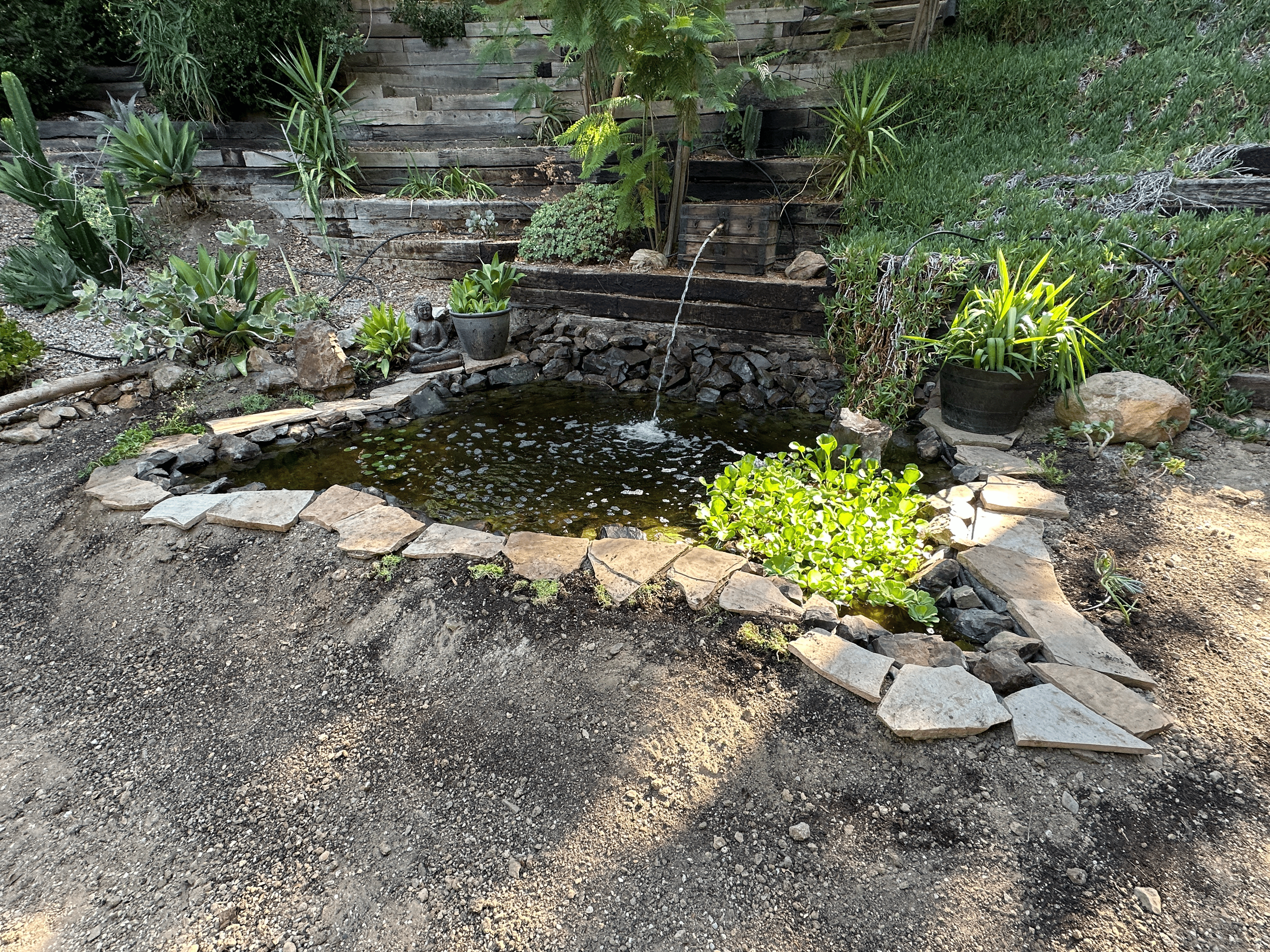
The rebuilt pond in Topanga, with stone edges, aquatic plants, a small fountain, and the first signs of a living ecosystem.
This week, for the first time, I sat down on one of the benches and simply watched the pond.
The fountain spilled from the old chest and broke against the surface. Butterflies moved in and out of the scene. Bees gathered around the water hyacinth. And the Buddha I had placed beside the rocks sat there quietly, almost as if it were looking back.
It was the first time the pond felt less like a project and more like a place.
There had been days on my knees with mud caked on my hands, leveling dirt shelves, shaping the edge, and trying to hide the liner so I would not run into the same problems as before.
I carried hundreds of rocks from remote corners of the property — through the woods, into the back of my car, across the gardens, and down the long steps to the pond.
There was one massive hero boulder I could barely budge by hand. Somehow, in the heat, I wrestled it onto a dolly and fought it uphill inch by inch.
There were leaks, adapters that didn’t fit, hidden pumps, aquatic plants, mosquito fish, irrigation lines, aches, fatigue, and plenty of moments when I wondered why I cared so much.
But now, sitting there and watching the pond come alive, I knew at least part of the answer.
Sometimes the practice is simply caring enough to keep going.
The Insight
At first, rebuilding the pond seemed like a practical problem.
Dig it deeper.
Shape the edge.
Protect the liner.
Move the stones.
Fix the pump.
Get the water moving again.
But the longer I worked on it, the more I realized the real work was not just making the pond function.
It was helping it belong.
That was the part that took the most attention.
If the liner showed, the whole thing felt unfinished. If the edge was too hard, the pond looked forced into the hillside. If the stones were too perfect, they looked decorative. If they were too random, they looked careless.
So I kept adjusting.
One rock at a time.
One fold of liner.
One shelf of soil.
One plant tucked into place.
The work asked for strength, but it also asked for sensitivity. I had to push, lift, drag, and carry. But I also had to notice. Where did the water want to sit? Where did the stone look natural? Where did the edge still feel exposed? Where did the garden seem to receive the pond, and where did it still resist it?
That was the surprising part.
A pond can hold water and still not feel like it belongs.
Sometimes belonging happens at the edges.
The Practice
I think practice works this way too.
We often want transformation to arrive as a breakthrough. Something dramatic. Something clean. Something that makes all the effort suddenly make sense.
But most of the time, it happens more slowly.
We return to the same place.
We notice what is not working.
We adjust.
We try again.
We get frustrated.
We keep going.
Meditation is not separate from that kind of work.
Sometimes practice is sitting quietly with the breath.
And sometimes practice is being covered in mud, overheated, tired, and still willing to place one more stone with care.
Sometimes it is the patience to fix what did not work the first time.
Sometimes it is the humility to admit that the first version was not quite right.
Sometimes it is the stubborn, unreasonable devotion to making something beautiful, even when no one else fully understands why it matters to you.
I still do not know exactly why this pond mattered so much to me.
But I know what it feels like to stand there now.
The water is moving.
The rocks have settled.
The plants are spreading.
The liner has mostly disappeared.
The fountain spills from the old chest.
The mosquito fish move quietly beneath the surface.
And the pond feels less like a project.
It feels like a place.
Maybe that is enough.
Maybe some things are worth doing simply because they make us feel more alive when they are finally brought into form.
Heard This Week
“Sometimes the practice is simply caring enough to keep going.”
