
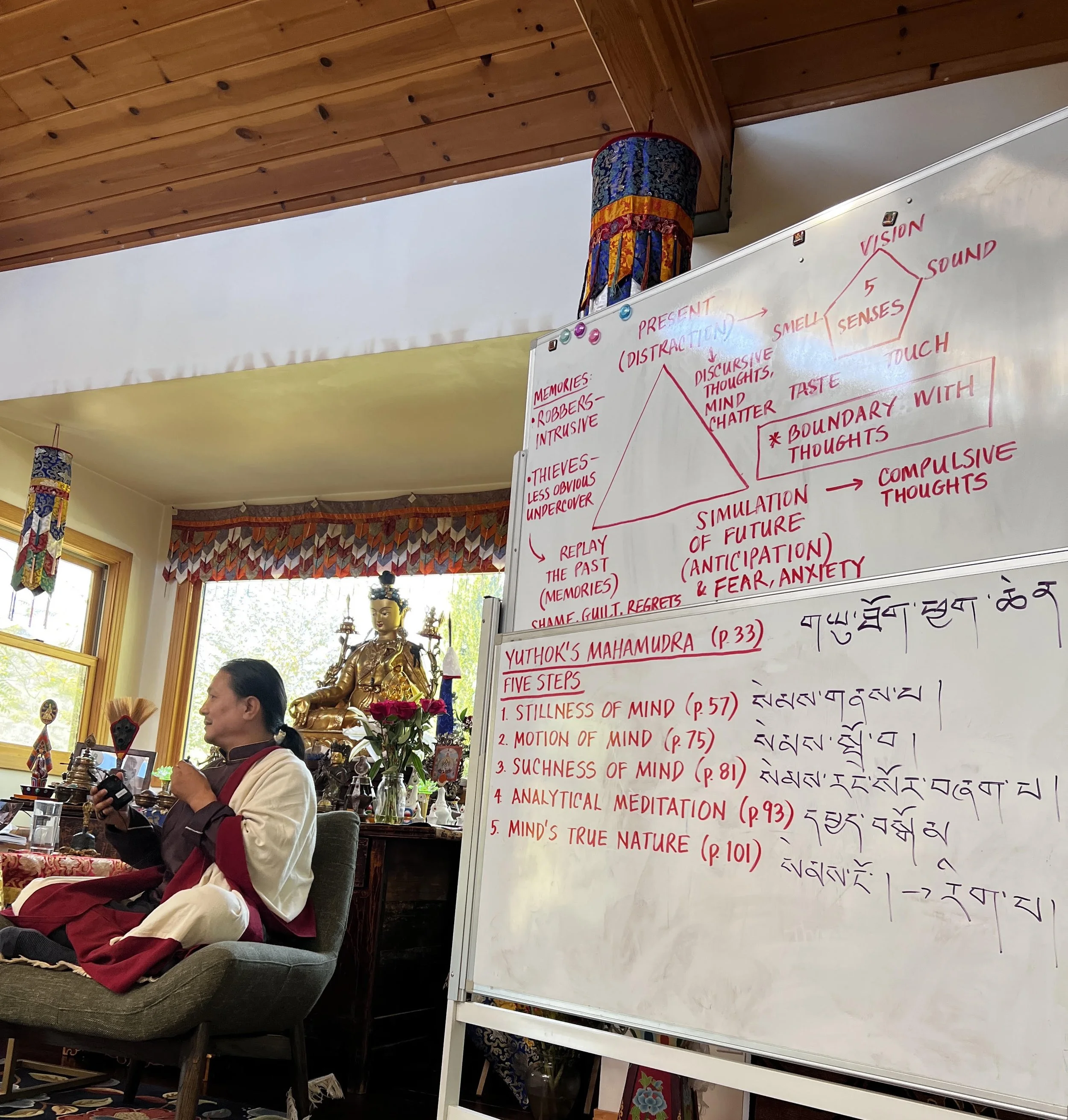
Dr. Nida Chenagtsang teaching Mahamudra meditation beside a whiteboard during a workshop at Pure Land Farms.
This weekend, we returned to Pure Land Farms for a workshop on Tibetan meditation, breath, and movement with Dr. Nida Chenagtsang.
We spent the day alternating between teachings and short meditation practices — often only two to five minutes at a time.
Dr. Nida kept the atmosphere light. He joked often, asked people questions, and regularly invited participants to share what they were noticing.
He kept emphasizing that meditation does not need to be long, that frequency matters more than duration.
Later, after the sun had gone down, the room became completely still.
Suddenly I could hear everything: a dog outside, goats on the hillside, birds, crickets.
From the Weekend
The workshop moved between three things: body, breath, and mind.
We learned some Tibetan yogic movements, which felt quite different from the forms of yoga I am more familiar with.
We also spent time working with the breath. One of the teachers explained how the same breath could take on a different quality depending on which part we emphasized.
A longer exhale could be calming. A longer inhale could be more energizing.
Even the pauses after the inhale or exhale could change the experience.
Then we would sit again.
At one point, we moved through meditations on each of the five senses: looking at a Buddha statue, listening to a handpan, feeling the touch of our own hand, smelling a natural perfume, and slowly tasting a piece of chocolate.
In between sessions, everyone wandered outside for tea and lunch.
We talked with other participants, browsed through books, and sat in the gardens before returning to the temple.
By the end of the day, Dr. Nida began introducing us to Mahamudra.
As I understood it, we first practiced noticing the quiet or empty quality of mind.
Then we intentionally introduced movement through the senses.
Rather than treating thoughts, sounds, sensations, or distractions as failures of meditation, we practiced recognizing that movement as part of the mind too.
From there, we looked at how distraction arises.
Sometimes it comes from what is happening right now.
Sometimes the mind moves forward into anticipation.
Sometimes it moves backward into memory.
And beneath all of those movements was a deeper question:
What remains when we stop defining ourselves only through our names, jobs, histories, identities, and roles?
The Insight
What stayed with me most was not a complicated teaching.
It was how quickly attention could change.
Two minutes of listening.
Three minutes of looking.
A few minutes of feeling the breath.
None of it seemed like very much.
And yet, by evening, I was sitting in a room where sounds I normally would have ignored suddenly seemed vivid.
The dog had probably been there all along.
So had the goats.
So had the birds and crickets.
The practice had not made the world more alive.
It had made me more available to it.
The Practice
Set aside three minutes.
Choose one sense.
Listen.
Look.
Feel.
Smell.
Taste.
Stay with just that one experience without needing to turn it into anything.
Then go back to your day.
A meditation does not always need to be long enough to feel important.
A few minutes is enough to notice what was already there.
Heard This Week
“A few minutes can be enough.”
